Humans have been using tools for thousands of years. Hammers have traditionally been used, for example, to straighten crooked nails. But that can also be quite painful! And so, in an age when powerful machines are used to manufacture nails, we’re only too happy to set the old tools aside in favour of an affordable new product for straightening process materials.
The elastic-plastic deformation of long process material sections or long goods is often necessary at various types of construction sites. In place of the simple hammer, the use of handheld straighteners is recommended. These supply the force and torque required to straighten the process material in a through-feed process, without changing the material’s cross-sectional geometry. It doesn’t matter whether the tool or the workpiece is fixed in place. The form curve of the process material changes over the length if there is a relative movement between the tool and the workpiece and the straightening rollers are positioned relative to one another. The benefits of a through-feed method compared with discontinuous straightening by means of three-point bending are improved manufacturing quality and higher throughput.
Performance density and easy handling
When designing its handheld straighteners, Witels-Albert always insists on performance density. In other words, high levels of in-process force and torsion can be achieved using straighteners with dimensions and masses that are small enough to ensure easy handling.
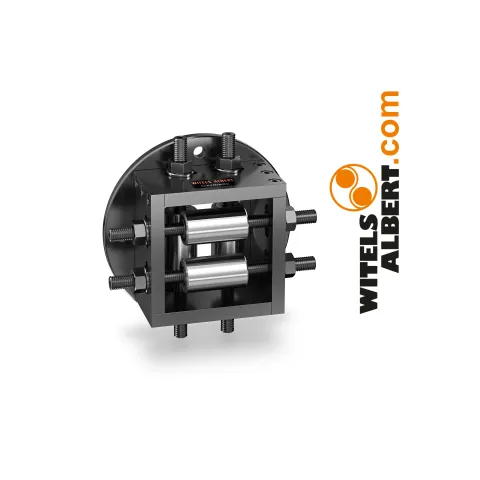
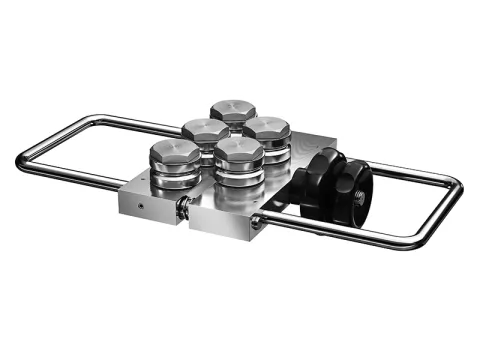
For this reason, almost all of the individual parts in these handheld straighteners are made from a tough non-ferrous alloy rather than steel. This alloy has a density that is two-thirds lower than that of steel, while also offering the additional benefit of being more resistant to corrosion. And the remaining parts of the handheld straightener also won’t succumb to this chemical reaction because they are made from high-quality stainless steel materials. On request, the same material can also be used to manufacture the straightening rollers, which come with a radius groove as standard. The rollers in each of the two rows on the straightener are screwed into position on separate planes, which can be moved centrically towards or away from each other.
The handheld straighteners are so well adapted to the rough conditions that prevail at construction sites that they are a pleasure to use, all the more so because additional features such as the quick-closing/quick-opening mechanism and the robust handles make the job of continuous manual straightening much easier. Handheld straighteners in the “SR” range are available in two sizes that can be equipped with five or seven straightening rollers. The models in the SPR 5 and SPR 7 ranges cover a total diameter range of 3 mm to 13 mm.
The following links will guide you to the PDF product specification sheets: